
MEDICARE
Who is Eligible?
Seniors 65+
The majority of our long-term care resources and planning options are designed specifically for individuals aged 65 and older as they transition into retirement.
Disability Support
Coverage and assistance are available for individuals under the age of 65 who are living with qualifying disabilities and require specialized care.
End-Stage Renal Disease
We provide dedicated support for people of all ages suffering from permanent kidney failure requiring dialysis or a transplant (ESRD).
When Do I Enroll?
Most people enroll around their 65th birthday. You can enroll during the 3 months before your birth month, the month of your birth and 3 months after that month giving you a 7 month initial enrollment period. Depending on when you enroll, coverage can start as early as the month of your 65th birthday.
If you miss your Initial Enrollment, you can sign up every year between January 1st and March 31. If you enroll at that time, your coverage is effective July 1st of that year.
Under certain circumstances, you may be eligible for a special Enrollment Period. If you have questions about that, please call me.
If you are still working and covered under employee group insurance you can either enroll in Medicare and drop your group coverage or you may be able to delay enrollment and stay with your employee program. You need to compare your plan at work side by side with your Medicare coverage and decide which is better for you. Before deciding to leave your employer plan, always discuss all of your options with your benefits administrator, insurer, or plan provider. In most cases once you leave, you cannot return to the employer plan.
How Do I Sign Up?

- Enrollment in Medicare is Automatic
- Card arrives in the mail about 3 or 4 months before your 65th birthday
You can start the enrollment process around 100 Days before your 65th birthday.
You can enroll two different ways:
- Call Social Security to
schedule an appointment
800-772-1213 - Sign up at medicare.gov
- Call Social Security to
What Exactly Is Medicare?

The original Medicare program was signed into law on July 30th, 1965. Former President Harry Truman and his wife were the very first beneficiaries. Today over 56 million Americans are enrolled in the Medicare program. That’s most Americans ages 65 and older, regardless of their income or health status.
You’re going to hear a lot about Medicare Supplement policies A through N. Original Medicare has only 2 parts: A and B. Part A is for hospital care and Part B is for medical services. Let’s start there.
Medicare Part A is usually free to you but you have to enroll. Once you do that – you can rely on the basic coverage or purchase supplemental coverage for additional protection.
Part A Hospital Care
For 2026, Medicare Part A is premium-free for most people. The Part A hospital deductible is $1,736 per benefit period, not $1,408. After that deductible, Medicare-covered inpatient hospital costs are $0 for days 1–60, $434 per day for days 61–90, and $868 per day for days 91–150 when using the 60 lifetime reserve days. After the lifetime reserve days are exhausted, the beneficiary pays all costs.
For a Medicare-covered skilled nursing facility stay, days 1–20 are $0, and days 21–100 are $217 per day in 2026. The benefit-period explanation in your wording is still important: a new Part A benefit period generally begins after the person has been out of a hospital or skilled nursing facility for 60 consecutive days. That means the $1,736 deductible can potentially be owed more than once in a year because it is per benefit period, not an annual deductible.
Part A — Hospital Insurance | 2026
- Premium-free for most people
- $1,736 deductible per benefit period
- Hospital days 1–60: $0 after deductible
- Hospital days 61–90: $434 per day
- Lifetime reserve days 91–150: $868 per day
- Skilled Nursing Facility days 1–20: $0
- Skilled Nursing Facility days 21–100: $217 per day
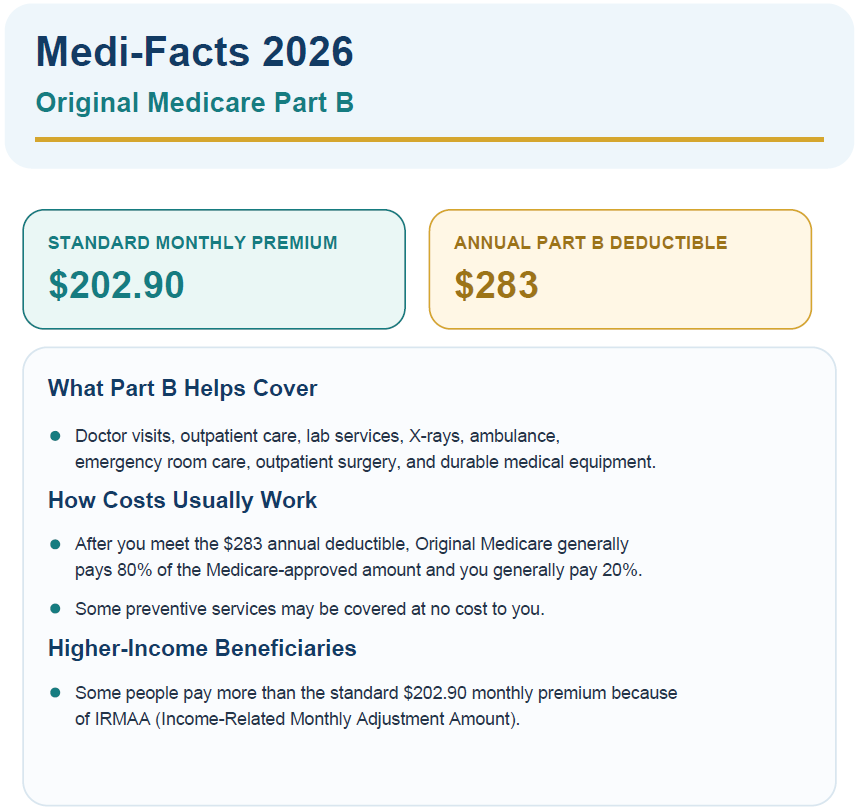
Part B Medical Services
$288 annual deductible
- Covers medical services outside the hospital
- Doctor visits, lab work, x-rays, ambulance, emergency room, outpatient surgery
- An 80-20 plan with Medicare paying 80%
- $288 annual deductible
an increase from $240 in 2024.
This deductible is the amount you must pay out-of-pocket each year before Medicare begins to cover your Part B services. After meeting this deductible, you typically pay 20% of the Medicare-approved amount for most doctor services, outpatient therapy, and durable medical equipment.
What you don’t get with A&B
Original Medicare doesn’t cover
- Dental
- Vision
- Prescription Drugs
- Hearing
- Help with long term care

When you DELAY Part B

If you or your spouse are working you may be able to delay enrolling in Medicare Part B, depending on the size of the employer…
If you are covered under an employer group health plan
You are covered under a spouse’s employer group health plan
- No Penalties
- No loss of Options
Now Where Do You Go…
Do you enroll in Part A, Parts A & B, Medicare Advantage or even a Medicare Supplement plan or do you continue with employer group health coverage or possibly union coverage?
You may also have the option of retiree coverage for health care after you retire but it does not count as creditable coverage for delaying enrollment into Medicare Part B, and neither does COBRA.
Medicare Options & Planning
Retiree or Union Plan
Compare employer or union plans to Medicare A & B. Consult your benefits administrator about:
- Copays and deductibles
- Included drug plans
- Opt-in/Opt-out rules
- Dental and vision coverage
*Note: Retiree coverage is not "creditable" for delaying Medicare Part B.
Medicare Supplement
Standardized Medigap plans (A–N) that cover costs Medicare doesn't. Coverage is identical for the same letter across providers.
- You want to budget fixed costs
- You travel frequently
- You want no referrals for specialists
- You want guaranteed renewability
Original Medicare vs. Medicare Advantage
Which Is Right for You?
Original Medicare
- See any doctor who accepts Medicare
- Pay a monthly Part B premium
- May want a Medigap plan for extra coverage
Medicare Advantage
- Often has a lower monthly cost
- Usually requires using a network of doctors
- May include extra perks like dental or vision
A Short List of Today's Real Numbers
- Part B monthly premium: $202.90 (2026)
- Part B yearly deductible: $283 (2026)
- Part A hospital deductible: $1,736 (2026)
These numbers are for 2026 and change every year.
Which Medicare Path Fits You?
Answer These 4 Questions
Do you want to keep seeing your current doctors, or are you okay switching to a new list of doctors?
- If you want to keep your own doctors → Original Medicare may fit better
- If you're okay with a set network of doctors → Medicare Advantage may fit better
Do you travel a lot or spend part of the year in another state?
- If yes, you travel a lot → Original Medicare may fit better (it works the same everywhere in the U.S.)
- If no, you mostly stay close to home → Medicare Advantage may fit better
Do you take several prescription drugs every month?
- If yes, several drugs → Look closely at drug costs on both paths, since this can change which one saves you more money
- If no, few or no drugs → Either path likely works fine for you
Which matters more to you: a lower monthly bill, or fewer surprise bills later?
- If a lower monthly bill matters more → Medicare Advantage may fit better
- If avoiding big surprise bills matters more → Original Medicare + a Medigap plan may fit better
There's no single right answer — it depends on you.
I'll go over your answers together and help you pick with confidence.
When you DELAY Part B

- Part D
- Prices vary by county, depending on the plan
- Included with some retirement plans
- Late enrollment penalties may be imposed
- Vets are not required to enroll, but may choose to do so
Financial Assistance & Coverage
Extra Help with Rx
You may qualify for a low-income subsidy to assist with deductibles, co-pays, and premiums if you meet the following criteria:
- Annual Income: Less than $18,735 (Singles) or $25,365 (Couples)
- Resources: Less than $14,390 (Singles) or $28,720 (Couples)
* Amounts based on 2019 data; subject to change in 2020.
2020 Rx Gap
Commonly known as the "Donut Hole," the coverage gap begins after you and your plan spend $4,020.
- Generic: You pay 25%
- Brand-Name: You pay 25% (95% counts toward out-of-pocket)
- Catastrophic: Coverage begins after $6,350
* Thresholds based on 2020 plan limits.
Don't Wait Until Its Too Late
The Right Plan Today Can Protect Your Tomorrow